 Mesa Mobile RV Repair
 RV Roof Repair, Resealing & Leak Repair in Mesa, Arizona
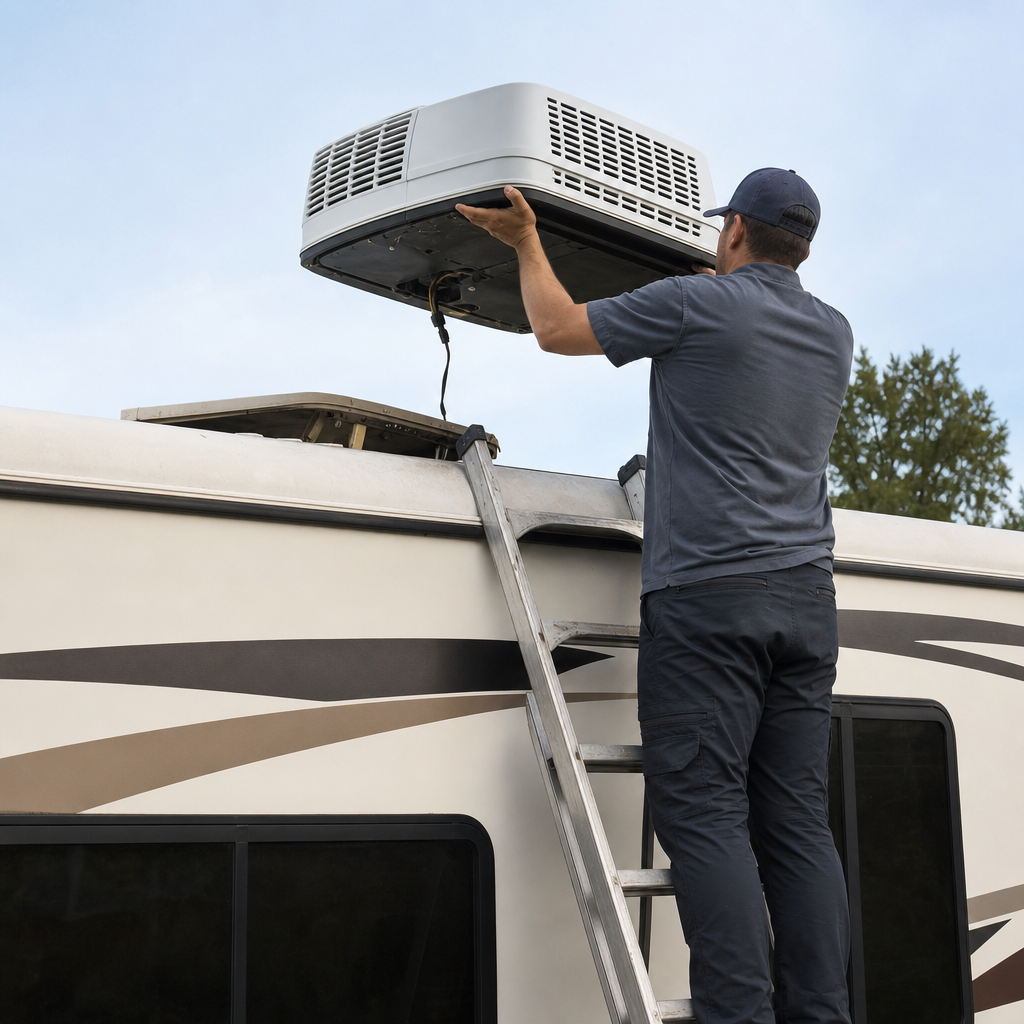
Arizona sun kills RV roofs: specifically, it kills the lap sealant around every vent, skylight, antenna, and seam, and then the July monsoon finds every crack. That gets repaired at your site anywhere in Mesa and the East Valley: dig out the failed sealant, clean the surface, and reseal, typically $500–$1,200 for a full reseal. The trip fee is $75–$150 and diagnosis comes first, like every other mobile job.
Why Arizona is a special case for RV roofs
Your roof isn’t one sheet of material. It’s a membrane (EPDM rubber, TPO, or fiberglass) interrupted by a dozen or more penetrations: vents, skylights, the AC unit, the fridge vent, antennas, plumbing stacks. Every one of those is sealed with lap sealant, a flexible bead that’s supposed to move with the roof. The membrane usually outlives everything; the sealant is the weak point.
In Mesa, that sealant lives a hard life. A roof in full sun runs far hotter than the air on a Phoenix-area summer afternoon, then cools overnight, so the bead expands and contracts every day for months, under some of the strongest UV in the country. Sealant dries, shrinks and cracks faster here than in a mild climate, which is why the manufacturers’ advice to inspect regularly matters more in the desert than anywhere else.
Then comes monsoon. The National Weather Service offices in the Southwest define the season as June 15 to September 30, and its storms drop intense rain (sideways, wind-driven rain) on roofs that have been baking and cracking since March. Water follows a crack into the seam, soaks into the wood decking under the membrane, and quietly rots it. By the time a brown stain blooms on the ceiling inside, the water has been in there for weeks. It is one of the most expensive preventable failures in RV ownership.
What a proper reseal involves
There’s a right way to do this, and a fast way that fails within a year. The right way:
- Full roof inspection. Every penetration, every seam, the membrane itself, and the condition of the decking underfoot. Photographed, because most owners can’t or shouldn’t climb up to look.
- Dig out the failed sealant. This is the step the cheap jobs skip. Cracked, lifted, chalky sealant comes out, new sealant applied over failing sealant is a fresh layer on a rotten foundation and it will not seal.
- Clean and prep. Residue, dust, and oxidation off the work area so the new material actually bonds to the membrane and the fixture, not to grime.
- Reseal with the right product. Self-leveling lap sealant on horizontal surfaces, non-sag formulations on vertical ones, checked against your membrane. Dicor lists its self-leveling lap sealant as compatible with EPDM, TPO and PVC membranes; fiberglass caps and vertical joints call for a different product, so read the label against the roof.
- Cure window. Dicor’s published times for its self-leveling lap sealant, at 50 to 70°F: skins over in 5 minutes, waterproof in 4 hours, 80% cured at 48 hours, fully cured at 30 days. Dry days ahead matter more than the first hour, which is why May–June is the Arizona reseal season: settled weather before the monsoon arrives to test the work.
A typical full reseal lands $500–$1,200 depending on roof length and how many penetrations it carries. Spot repairs on one or two failed points cost less, and if that is all the roof needs, that is all the quote should include.
When it’s beyond a reseal
If water has already been inside (soft spots underfoot, staining inside, a spongy feel around a vent) the job changes. Wood-rot repair and membrane replacement run $2,000–$3,000+ and sometimes more, depending on how far the water traveled. We show you the photos before the quote, because the difference between “reseal now” and “rebuild the decking” is exactly the kind of thing you should see with your own eyes. And if the damage is severe enough that an insurance claim makes sense (monsoon hail, wind-driven debris) ask for photos and a written scope for your adjuster.
The math is lopsided and worth saying plainly: a $700 reseal in June can prevent a $3,000 repair in September. This is the most cost-effective money an Arizona RV owner spends.
Resort rigs and stored rigs both need this
Roof failure doesn’t care whether the rig is occupied. In the Main Street corridor parks (Mesa Regal, Towerpoint, Silveridge, Valle del Oro, and their neighbors) rigs sit under full sun on their spaces all year, including the summers their owners spend in Michigan. In the storage yards across Gilbert, Tempe, and Queen Creek, uncovered rigs take the same UV load with nobody checking on them at all. Covered storage helps genuinely; it doesn’t make roofs immortal.
The pattern to plan around: an owner returns in October after five months away, and the monsoon has already found the seam that cracked in May. If your rig summers in Arizona without you, on a resort space or in a yard, a spring inspection and reseal before you leave is the cheapest insurance available.
Roof coatings and cleaning in Mesa sun
A full roof coating is a different job from a reseal: it goes over the whole membrane, not just the penetrations. Two manufacturer rules decide whether it lasts here. Dicor says not to apply its coating in direct sunlight, because it can cure too quickly and flake off, and to wait about 1.5 to 2 hours between coats. On a Mesa summer day that means early morning, a shaded carport, or the cooler months, not a 2 p.m. job on an open space.
Cleaning comes first either way, and the same rule covers both jobs: no petroleum-distillate, abrasive or citrus cleaners on EPDM or TPO. A roof that was “conditioned” with the wrong product can keep new sealant or coating from bonding.
What it costs and how to book
| Job | Typical range |
|---|---|
| Roof inspection with photos | Trip fee + first diagnostic hour |
| Spot reseal (one or two penetrations) | $150–$400 |
| Full reseal (all penetrations and seams) | $500–$1,200 |
| Membrane / wood-rot repair | $2,000–$3,000+ |
Trip fee $75–$150 in the local area; labor $125–$190/hr within those job ranges. The reseal row is the affordable one in that table by design. Its whole job is keeping your rig out of the wood-rot row. Full details on the pricing page. Every number gets your approval before work starts.
Send the year, make, and model, where the rig is parked (resort and space, storage yard, or driveway) and when it was last resealed, if you know. If the answer is “no idea,” that is itself the answer: it’s time to get eyes and a camera up there. If it’s currently leaking, say so, active water intrusion jumps the queue. More questions? The FAQ covers the common ones.
Frequently Asked Questions
How much does an RV roof reseal cost in Mesa?
A typical reseal (dig out failed lap sealant and reseal vents, skylights, and seams) runs $500–$1,200 depending on roof size and how many penetrations it has. Full membrane work or wood-rot repair is a different job at $2,000–$3,000+.
How often should I reseal my RV roof in Arizona?
Look at it at least every spring before the monsoon, and expect to touch up high-wear points more often than you would in a mild climate. A roof in full desert sun runs much hotter than the air and cools every night, and that daily expansion and contraction under strong UV is what cracks lap sealant around vents and seams.
When is the best time to reseal, and when is the worst?
May–June is the smart window: before the monsoon (June 15 to September 30 by the National Weather Service's definition) brings its storms, with dry days for the sealant to cure properly. The worst time is after the leak, once monsoon water is inside a seam, you're paying for the reseal plus whatever the water ruined.
Can you just put new sealant over the old cracked stuff?
No, and walk away from anyone who offers. New sealant over failed sealant just makes a fresh layer on top of a failing one. The old material has to come out, the surface gets cleaned, and then new self-leveling sealant goes down. That's most of the labor, and it's why the job is worth paying for.
I can't climb up there anymore. How do I know what shape my roof is in?
Nobody in the 55+ parks should be on a ladder over an RV roof, and Dicor's own FAQ warns that a wet membrane can be extremely slippery. Ask us for photos of every vent, seam and skylight, and we walk you through them on the ground. You see exactly what the inspection shows before deciding anything.
What should I clean an RV rubber roof with in Arizona?
A cleaner made for the membrane. Dicor, which makes the lap sealant most RVs leave the factory with, says not to use cleaners or conditioners containing petroleum distillates, harsh abrasives or citrus-based cleaners on EPDM or TPO, and to skip anything scented, which draws birds and insects. Clean before any reseal so the new sealant bonds.
More rvrepair services
- Mobile RV Repair in Mesa: We Come to the Rig
- RV Air Conditioner Repair in Mesa, Arizona
- RV Slide-Out Repair in Mesa, Arizona
- RV Plumbing Repair in Mesa, Arizona
- RV Appliance & 12V Electrical Repair in Mesa, Arizona
- Mobile RV Fiberglass and Body Repair in Mesa
- RV Generator Repair in Mesa
- RV Electrical Repair in Mesa
- RV Maintenance and Pre-Season Service in Mesa