 Mesa Mobile RV Repair
Mobile RV Repair in Mesa: We Come to the Rig
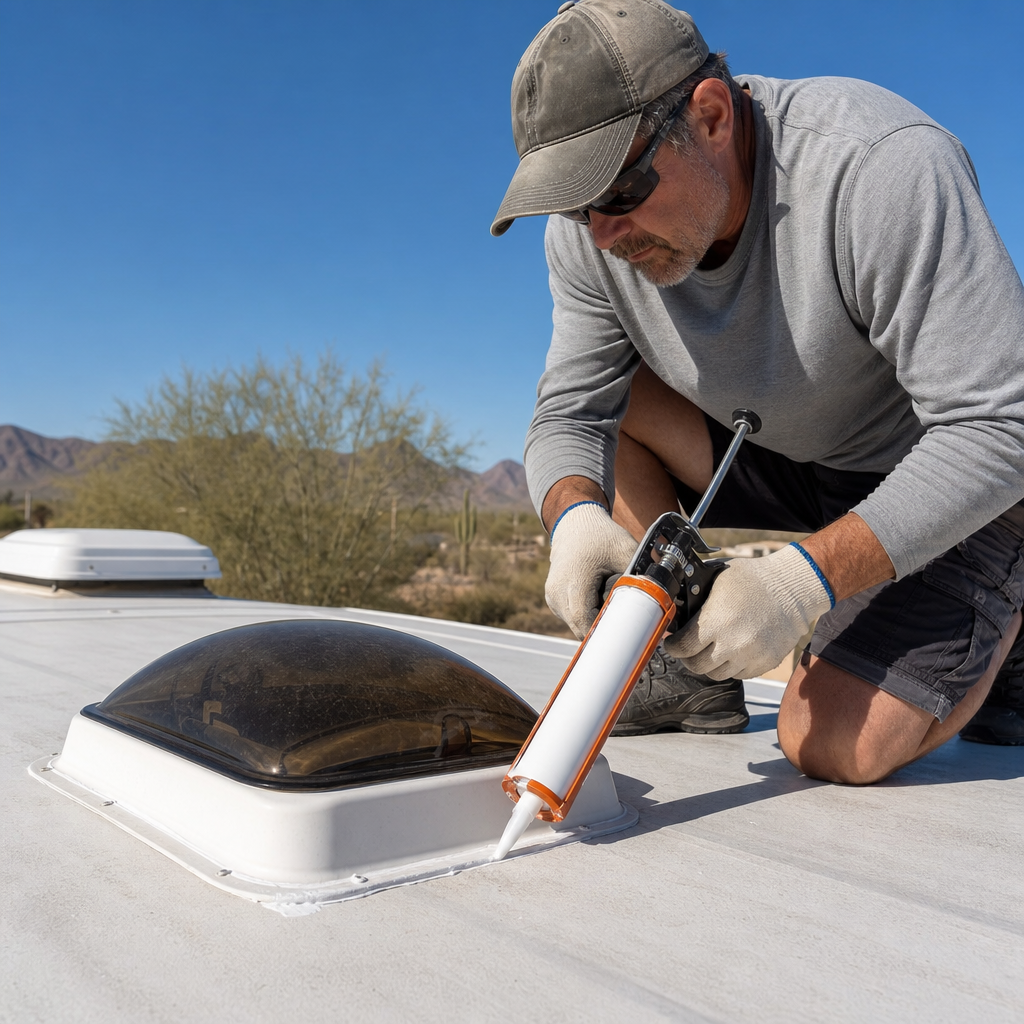
Mobile RV repair means our tech drives to your rig (at a resort space, a storage yard, a driveway, or wherever it’s stuck) and diagnoses and repairs it there. No hitching up, no towing, no living out of a hotel while a dealer works through a six-week backlog. In Mesa, the trip fee runs $75–$150, labor is $125–$190/hr, and you approve every number before work starts. See the full pricing breakdown for typical complete-job ranges.
Why this service exists in Mesa specifically
East Mesa’s Main Street–US-60 corridor is one of the largest concentrations of RV resorts in the United States. Mesa Regal runs about 2,000 sites. Towerpoint has more than 1,100. Valle del Oro on Ellsworth holds around 1,700. Add Viewpoint, Monte Vista, Silveridge, Aztec, and the string of parks continuing east into Apache Junction, and tens of thousands of rigs sit parked within a few miles of one another, most occupied October through April, a solid core of full-timers year-round.
Almost none of those rigs can practically go to a shop. A fifth wheel set for the season has its slides out, skirting on, utilities connected, and a household’s worth of living arranged around it. Breaking all that down for a water heater problem is absurd. Meanwhile the region’s dealer service departments book out 2–6 weeks in season, and most move their own customers to the front of the line. The rig can’t come to the repair, and the repair queue is weeks long, so the repair comes to the rig. That’s what we do.
What gets repaired on-site
We cover the house side of the rig, the systems that actually fail in the desert:
- Roof and sealant: cracked lap sealant, leaking vents and skylights, seam failures. In Arizona this is preventive medicine; see the roof repair page for why the sun here is a special case.
- Rooftop air conditioning: start capacitors, fan motors, coil cleaning, and full AC unit replacements done at your site.
- Slide-outs: motors, rack-and-gear mechanisms, and synchronization problems, fixed where the rig sits, because a rig with a stuck slide isn’t going anywhere anyway.
- Plumbing: water pumps, valves, lines, and fresh/gray/black tank problems.
- Appliances and 12V: water heaters, furnaces, batteries, converters, fuses, and lighting, covered under appliance repair.
- Electrical: power that drops at the pedestal, dead outlets, transfer switches, and melted shore-power plugs, covered under RV electrical repair.
- Body damage: storage-lot scrapes, compartment doors, gelcoat cracks, and trim, covered under mobile RV fiberglass repair.
- Scheduled maintenance: the October arrival checkout, the pre-monsoon roof check, and storage prep, covered under RV maintenance.
Not covered: engine, transmission, brakes, suspension, drivetrain. That’s a truck shop’s work, and we say so instead of experimenting on your chassis at $150 an hour.
Class A, Class C, fifth wheel, travel trailer: does rig type matter?
Less than owners expect, with a few honest exceptions. The house systems are largely the same hardware whether they’re bolted into a Class A diesel pusher, a Class C on a cutaway chassis, a fifth wheel, or a bumper-pull travel trailer: the same Dometic and Coleman rooftop units, Suburban and Atwood water heaters, and Lippert slide mechanisms turn up across all of them, so diagnosis and rates don’t change with the type. What changes is access and layout. Class A roofs sit higher and often carry two AC units. Class B camper vans pack everything into tight cabinetry, which can add labor time. Fifth wheels and travel trailers are where most of the corridor’s slide-out work lives, and park models get the same appliance, plumbing, and 12V service minus anything that’s crossed into residential construction. The one type-specific job people ask about that is out of scope: wheel bearing repacks and axle brake service on trailers. That’s running gear, not house systems, and it belongs at an axle shop, not with someone learning on your axles. Give the type along with year, make, and model, so we arrive set up for it.
How a call actually runs
Intake. You send year, make, and model; what’s failing and when it started; and precisely where the rig is parked. In a resort, that means the park name and space number: gate procedures, visitor passes, and quiet hours are daily logistics for us, and good access info is the difference between a smooth visit and a wasted morning. In a storage yard, include the yard’s access hours and your row.
The call-out. The trip fee covers travel and the first diagnostic window. Our techs carry the parts that close most calls in one visit: fuses, lap sealant, capacitors, anode rods, water pumps, thermocouples.
Diagnosis before quote. We test, meter, and inspect before naming a price. This is the step that separates real repair from parts-swapping. An AC that hums but won’t start gets a capacitor test before anyone says “new unit.” A dead water heater gets its thermocouple and igniter checked before anyone quotes $1,500. You get a straight repair-versus-replace recommendation with numbers attached.
The work. Common failures get fixed on the spot. When a part must be special-ordered (honestly, RV parts supply is slow; special orders can take days), we book the return visit before we leave, so you’re never wondering what happens next.
The walkthrough. You get a function test of the repaired system with you watching (or on video if you’re remote), a plain-language explanation of what was done, and a flag on anything else we spotted along the way. Ask us for roof observations with photos, since most owners in the 55+ parks along Main Street haven’t been on their own roof in years, and shouldn’t be.
Storage-yard and driveway calls
Not every rig lives in a resort. Plenty of East Valley RVs sit in storage yards, along the 202 in Mesa, on Houston Ave in Gilbert, in the big lots out toward Queen Creek, or in driveways between trips. Storage-yard calls are their own discipline: no shore power (we bring what is needed), gate-access windows to respect, and rigs that haven’t been opened in months. The classic storage-yard call is the pre-trip checkout that finds the dead battery, the fridge that won’t start, and the tires that aged a summer’s worth in three months of 110°F afternoons, before you find them at 70 mph on the way to the rim country.
Driveway calls in Mesa, Gilbert, and Tempe are the simplest of all: power available, owner present, easy access. If your HOA runs a parking clock on visible RVs, mention your window so the visit can fit inside it.
Independent, and up-front about it
We are not a dealer and not factory-authorized, which cuts both ways and you deserve both halves. The downside: no manufacturer warranty work. If your component is still under warranty, check with the manufacturer before paying anyone, some reimburse independent repairs, many don’t. The upside: every brand is fair game, the prices are published, and a mobile visit is usually measured in days rather than weeks. For a rig that’s parked for the season in the biggest RV corridor in the country, that trade is usually easy.
Send what’s wrong and where the rig sits (resort and space, yard and row, or address) and ask for a date and a cost before anything is booked. More on how we operate is on the about page.
Frequently Asked Questions
What does a mobile RV repair visit cost in Mesa?
Trip fee $75–$150 within Mesa and the close-in East Valley, covering travel and initial diagnosis, then $125–$190/hr labor with a one-hour minimum plus parts. You approve the full number after diagnosis, before any work starts.
What can actually be fixed on-site versus needing a shop?
Nearly everything on the house side: roof and sealant, rooftop AC, slide-outs, water heaters, furnaces, plumbing, tanks, and 12V electrical. What needs a shop is chassis work (engine, transmission, brakes), which is outside mobile RV repair, and we will tell you that straight.
How do you handle resort gates and park rules?
Give your resort name and space number at booking. Our tech checks in through the visitor gate like any guest and works around quiet hours. The Main Street corridor parks see mobile techs constantly, so the front gates know how it works.
Can you fix my RV if it can't move at all?
That's exactly the point of mobile service. Dead chassis batteries, a slide stuck out, failed leveling jacks, or a rig planted for the season with skirting on. The repair comes to it. Say where it sits and we can come diagnose it there.
How soon can you come out?
That depends on our calendar, which runs apart from the 2–6 week dealer backlog common in season. October through December is the crunch, thousands of rigs arriving at once, so call early. Genuine emergencies like active roof leaks get priority.
Do you work on travel trailers and fifth wheels, or just motorhomes?
All of it: travel trailers, fifth wheels, toy haulers, Class A, B, and C motorhomes, and park models on the house side. The house systems are mostly shared hardware across types, so rates don't change with the badge. The one exception is trailer running gear, wheel bearing repacks and axle brakes, which is axle-shop work and belongs there.
More rvrepair services
- RV Roof Repair, Resealing & Leak Repair in Mesa, Arizona
- RV Air Conditioner Repair in Mesa, Arizona
- RV Slide-Out Repair in Mesa, Arizona
- RV Plumbing Repair in Mesa, Arizona
- RV Appliance & 12V Electrical Repair in Mesa, Arizona
- Mobile RV Fiberglass and Body Repair in Mesa
- RV Generator Repair in Mesa
- RV Electrical Repair in Mesa
- RV Maintenance and Pre-Season Service in Mesa